
Contents
What is a Pocket Binocular?
In the world of binoculars one can clearly distinguish between binoculars of normal size and binoculars known as “compact binoculars”. These are distinctions known and conducted by the manufacturers, but among the users of binoculars a third type has emerged, known as “pocket binoculars”. Even though this denotation has become very popular, manufacturers have been rather slow in incorporating it in their terminology as part of the name of a special kind of compact binocular. As a matter of fact, only five models with the word “pocket” as part of the name are available at Amazon, whereas close to 100 have the name “compact” included in the name.
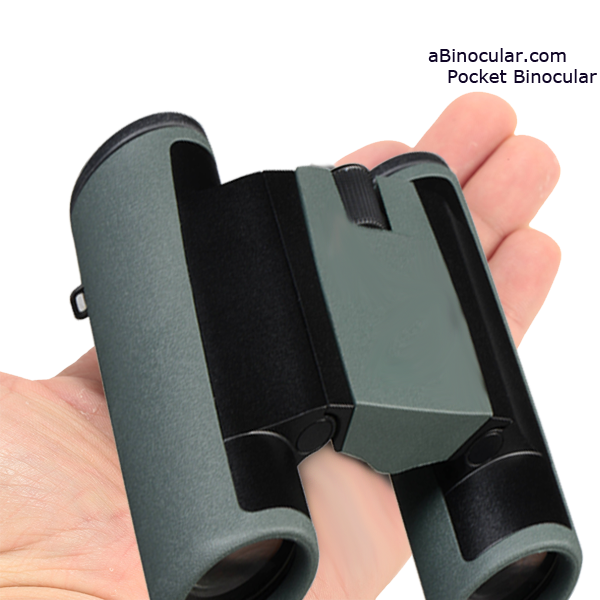
Are all compact binoculars pocket binoculars?
Many people think so. Not at all. Firstly many compact binoculars are generally too big to fit into the pocket, even if they are said to be “compact” binoculars. Furthermore, many compact binoculars are simply too heavy, weighing more than 20 ounces – even though they might be small enough to fit into your pocket.
However, the good news is that you will get many compact binoculars which fit the definition of “pocket binoculars”, being small enough as well as light enough, even though there’s nothing in the name suggesting it. So you have a lot more options as it seems. Stick with us and we’ll help you with that!
So what is meant by a “pocket binocular”? When does a binocular qualify to be called a “pocket binocular”?
There are two obvious requirements
- They have to be small enough to fit into a shirt pocket or anything similar. The length of the barrels could be 6 inches (153 millimeters)(it’s not that issue if they can stick out at the top of your pocket) and the height should be around 3 inches (77 millimeters). The width is the crucial dimension. Four inches (101 millimeters) should be fine. My pocket takes a 4.5 inches one. Clearly one should not be put off by a few millimeters, as long as the weight does not become an issue. The sizes of shirt pockets differ in any case.
- On top of this, they also have to be light-weight enough not to bother the viewer when carried in his pocket. Frankly speaking, a really classic pocket binocular should not weigh more than 12 ounces. (340 grams). An perfect example is the Steiner 10×26 Safari Binocular that weights only 9.7 ounces (275 grams). However, if this requirement is strictly applied, a special category of compact binoculars, known as “reverse porro binoculars”, will have to be excluded, even though some of them should be regarded as pocket binoculars. If you fancy them, you will have to go a little higher – say to 16 ounces. An excellent example is the one-of-a-kind and very popular Pentax Papilio 6.5x21mm Super-Close Focus Binoculars (also available in 8.5×21), which is a reverse porro design, small enough to fit into your shirt pocket with dimensions of 4.5 x 4.3 x 2.2 inches, but weighs 16 ounces.
Considering issues to choose a pocket binocular:
1. Usage
Why do you want a pocket binocular? When do you intend using it? Do you think that this binocular will be only pair for you? Or do you have another one and you want o use this as an extra? Will this be the one you will be taking on hiking trips or to sports games? Or are you buying it for your teenager kid? This is important not only in terms of how much you’re willing to pay, but also what model will suit you best.
2. Budget
What is your budget and how much amount is comfortable for you to buy this? Will it be the only pair of binoculars you have, or just an extra one you will be using while going hiking or traveling? You have to make a decision as to how much you’re willing to pay, since there are ones available for more than $500 at the upper end of the market (e.g. the Carl Zeiss Victory Compact Binoculars (10×25), Swarovski Optiks Pocket Binocular Crystal Idomeneo 8×20: $800) and ones for less than $150 at the lower end (e.g. the Tasco Compact Binoculars 8x25mm Md: 167CR). If it will be the only binocular you’ll have, you might be willing to pay more. In the case of binoculars price and quality go hand in hand. Even if you’re not going for the expensive ones, sacrificing quality should never be an option. Fortunately, there’s a number of quality ones available at reasonable prices, like the MINOX BV 10×25 Waterproof Binocular, which sells for less than $150 at Amazon.
3. Quality
A pocket binocular doesn’t make it an inferior binocular. You should need compact, full size or pocket binocular without sacrificing the quality of the product. Lenses and coatings: Make sure that the lenses are made from Bak-4 glass and are “fully multi-coated”, like in the case of the Steiner 10×26 Safari Binocular. Excellent optics will have to make up for the fact that the smaller apertures (objective lenses) will let in less light than in the case of ordinary size binoculars. The challenge will be to get the best optics within your budget limitations and so try to ensure that the images arriving at your eyes are clear, sharp and color-true. Weatherproof: A weatherproof (water- and fogproof) instrument is always a good idea, in particular if you intend using it on trips in the great outdoors, like on hiking trips. It’s not that noteworthy that all ones in the medium to higher price ranges are weatherproof, but it is exceptional that the MINOX BV 10×25 Waterproof Binocular , going for less than $150-00 at Amazon, is weatherproof. All the more expensive ones in our selection are weatherproof.
4. Overall dimensions
Men normally have bigger hands than women and this will have to be considered before buying a one. The slightly bigger reverse porro models, like the Brunton Echo 10×28 Reverse Porro Prism Compact Waterproof Binoculars will suit them perfectly, but that goes for all the models in our selection, although the Weaver Classic 8X24 Binoculars (Matte) might be a bit small for men. Pocket sizes differ as well. In any case, do not hesitate to go for the slightly bigger or slightly heavier one. A real small one might be cute and unobtrusive, but you might end up having a pocket binocular too small to handle! Make sure this does not happen!
Popular Pocket Binoculars
The following list of pocket binoculars have been carefully selected and arranged according to different price ranges for your convenience. These are mostly roof prisms, but a short list of reverse porro designs have also been included at the end.
Top Pocket roof prism binoculars
Top of the range
- Carl Zeiss Victory 8x20B T* P* Compact Binoculars w/Pouch (8 oz.) ($600+)
- Leica 8×20 BCR/Black Ultravid Compact Binocular (9 oz.) ($600+)
- Swarovski Optiks Pocket Binocular Tyrol 8×20 (only 6.7 oz.) ($800+)(see reviews on all Swarovski pocket binoculars).
- Swarovski Optiks Pocket Binocular Crystal Idomeneo 8×20 (only 6.7 oz.) ($800+)
Pocket binoculars under or above price $300
1. Nikon Premier LX-L 10×25 Binoculars, weighing less than 10 oz.
2. Nikon Premier LX-L 8×20 Binoculars, weighing less than 10 oz.
Pocket binoculars under or above price $150
- Weaver Classic 8X24 Binoculars (Matte), weighing only 8.1 oz.
- Weaver Grand Slam 10.5X25 Compact Binoculars 800595, weighing only 8.8 oz.;
- Steiner’s Wildlife Pro 8.5 X 26 Steiner, weighing only 9.7 oz.
- Leupold Olympic Binoculars 8x25mm Compact DH Black Md: 65775, (10.4 oz.);
- Steiner 10.5×28 Wildlife Pro, weighing 11 oz.
- Steiner 12×30 Wildlife Pro, weighing 13 oz.
- Pentax 62599 9×28 DCF LV Binocular – Black , (13 oz.). This popular binocular is currently selling at a discount of 55%!
- Columbia Backcountry 10×25 Pocket Roof Prism Binocular (14.1 oz.).
Pocket binoculars at Budget range (Under $150)
- Tasco Compact Binoculars 8x25mm Md: 167CR (9.6 oz.) (currently unavailable);
- MINOX BV 10×25 Waterproof Binocular (10.4 oz.)
- Pentax 62594 10×25 DCF SW Binocular – Black (10.6 oz.)
- Columbia Timberline 8×32 Compact Roof Prism Binoc (11 oz.);
Pocket porro prism binoculars under $150
- Nikon 7471 Travelite V 9×25 Binocular
- Nikon 7511 Travelite 12 X 25 mm V Binoculars
- Nikon 7508 Travelite 8 X 25mm V Binoculars
- Nikon Travelite V 10×25 Binocular (only 8.8 ounces);
- Pentax 62211 UCF-X II 8×25 Binocular (10.6 oz.)
- Pentax 62608 UCF 8×25 Waterproof Binocular (12.3 oz.)
- Nikon ProStaff ATB 9×25 Waterproof Binocular (12.5 oz.);
- Brunton Echo 10×28 Reverse Porro Prism Compact Waterproof Binoculars (13 oz.);
- Pentax 62593 8×25 DCF SW Binocular – Black (13.6 oz.)
- Pentax Papilio 6.5x21mm Super-Close Focus Binoculars (16 oz); (close focus)
- Pentax 62216 Papilio 8.5×21 Porro Prism Binocular (16 oz); (close focus).
What type of pocket binocular should you be looking for?
There are two basic designs in binoculars: The traditional “porro prism binoculars” and the so called “roof prism” binoculars. The porro prism binoculars have an offset zig-zag design, with the eyepieces (where you put your eyes) and big objective lenses (at the front) not in the same line, the objective lenses being wider apart than the eyepieces. These type of binoculars are by design heavier and bulkier than the other type, the roof prism binoculars, and will never fit into your pocket.
However, by having the objective lenses closer together than the eyepieces the porro design can be made compact – the so-called “reverse porro”. These are excellent compact binoculars, and although they tend to be heavier than roof prism binoculars, some of them will fit into your pocket and will be light enough to pass as a pocket binocular. An excellent example of a reverse porro compact binocular is the Bushnell Legend 10×26 Compact Porro Waterproof Binocular, which might be small enough to fit into your pocket (dimensions: 6.2 x 5.6 x 3.3 inches), but is a bit too heavy (22 ounces) to be comfortable. However, the Pentax Papilio 6.5x21mm Super-Close Focus Binoculars (also available in 8.5×21), which is a reverse porro design, small enough to fit into your shirt or jacket pocket with dimensions of 4.5 x 4.3 x 2.2 inches, but at 16 ounces it might be a little too heavy (as a pocket binocular) for a some people. The 8.5×21 weighs the same, but is slightly bigger with dimensions of 6x6x3 inches and maybe just too big to fit into a shirt pocket.
On the other hand, some reverse porro binoculars can be just as light-weight as roof prisms binoculars. The Galileo 8×22 Mini-Compact Binoculars weigh as little as 8 ounces! But these are a few and far between.
The other type of design is the roof prism binoculars, where the eyepieces are situated directly behind the objective lenses. Whether big (normal size) or compact, they are sleek and streamlined . This means that they are perfectly designed for not only being compact, but indeed being pocket size as well. They not only weigh less than the other type (“porro”), but are smaller by design as well; on top of this, they can fold even smaller when not used. My 8×25 pocket roof prism binocular is 3.94 inches (100 millimeters) wide when folded open to fit my eyes, but folds down to 2.76 inches (70 millimeters) when I put it in my pocket. As a matter of fact, some roof prism pocket binoculars are so small, they are simply just too small for an adult person to handle with comfort, like the Audubon 4100 Mini Binoculars 7×18 (dimensions: 2 x 2.5 x 4.2 inches), or the Tasco Essentials 8×21 Binocular (dimensions: 4.2 x 3.2 x 2.2 inches ; 8.8 ounces) from Bushnell. So you have to look out for that as well.
The Cons of pocket binoculars
Brightness of image
The objective lenses of pocket binoculars are considerably smaller than the size of ordinary binoculars, and smaller than many compact binoculars as well – usually 20-25mm in diameter. The smaller the lenses, the less light that enters through the lenses. This is of no concern in bright daylight, but when looking at something in the shade of a tree, or in dim light, you will end up with a less vivid image as would be the case in ordinary binoculars with objective lenses double their size. This makes it imperative that you choose a pocket binocular with as good optic features as you can afford. The coatings should be fully multi-coated, like in the case of the Pentax 62593 8×25 DCF SW Binocular.
Field of view (FOV)
FOV is the width of the view at the particular distance, e.g. 380ft. at 1000 yds. The wider the FOV, the easier to find objects and follow moving objects. Since both the diameter of the objective lenses (aperture) and the magnification play a role in determining the FOV of a binocular, pocket binoculars normally have a smaller FOV’s (smaller apertures). If you insist on the same FOV as your big binoculars, you will have to settle for a less powerful (lower magnification) binocular. The higher the magnification of your pocket binocular, or/and the smaller the aperture, the narrower the field of view. However, it has to be noted that the FOV is mainly determined by the optical design of the eyepieces. A narrower FOV is not the end of the world, but it is handy when viewing moving objects.
Good optical design can save the day for pocket binoculars as far as FOV is concerned, as illustrated in the following examples: The KOWA 8×25 Roof Prism Wateproof Binoculars has a FOV of 331 feet and the Weaver Classic 8X24 Binoculars has a FOV of 315 feet. This compares favourably with the 330 feet FOV of an ordinary size Nikon 7294 Monarch ATB 8×42 Binocular.
The Pros of Pocket Binoculars
Small is big! A pocket binocular can be so small, when folded up (the roof prism type) you can hold it in your hand without even being noticed. Check out how compact does this Swarovski Optiks Pocket Binocular (8x20B-P, Black) folds up with its double hinge folding mechanism:
You can put it in your hand luggage when travelling or just hold it in your hand while passing through the checkpoints.
Since it fits into your pocket, it does not bother you when hiking or watching a sports game. Both hands are free until you need to use the binocular. Avid bird watchers like to have a pair of binoculars available wherever they go, just in case something special pops up – not only when being out in Nature watching birds, or doing a hiking trail. You might even spot a special bird through you office window, when stuck in traffic or going for a stroll after work. So a small binocular fitting into your shirt pocket will always be handy.
The fact that they are very light-weight establishes another big advantage. You can take them wherever you go, walk miles, spend days in the mountains hiking, go to big sports events – and hardly be aware of them. They are no burden at all. But the moment you take them out and let them do their magic, you are taken by surprise time and again: That such a small and unobtrusive instrument can open up the world around you to such an extent! Pocket binoculars might be small, but are not inferior to ordinary or compact binoculars as such. They can magnify a bird just as many times as their big brothers and the image can be just as sharp and clear. However, one has to be very careful to go for quality and not end up with a cheap, attractive-looking – but useless – little binocular. But then, the need for quality applies to compact and ordinary binoculars as well!